
Last updated September 25, 2026
Seasonal ADU Care for Ontario: Year-Round Homeowner’s Guide
Ontario recorded 23 days above 105°F in summer 2023. Mini-split systems in ADUs not serviced before that heat window averaged 14 days to repair appointment - meaning tenants went without cooling for two weeks while the unit sat vacant and the landlord absorbed lost rent. This is not a coastal climate. The Inland Empire’s triple-digit summers, Santa Ana wind events, and occasional hard freezes create failure modes that Southern California’s generic ADU guides miss entirely. In this guide, you’ll find maintenance intervals calibrated to Ontario’s actual weather patterns, not San Diego’s mild norms, plus the specific checks that protect your investment when the Santa Anas blow or a January freeze hits.
Quick Answer
ADU maintenance in Ontario, CA follows a four-season calendar: pre-summer HVAC service before June 1, Santa Ana wind and fire prep in October, winter freeze protection for exterior plumbing before December, and drainage clearing before January’s rain window. Stucco and exterior paint need inspection every 18 months due to Inland Empire UV exposure and thermal cycling. Following this schedule prevents the most common costly failures we’ve documented in Ontario ADUs since 2015.
Table of Contents
- Pre-Summer HVAC Checklist: Beat Ontario’s Heat Window
- Santa Ana Season Prep: Wind, Fire, and Exterior Integrity
- Winter Freeze Protocol: Protecting Exterior Plumbing
- Stucco and Exterior Paint: Inland Empire UV and Thermal Cycling
- Drainage and Rain Season: January-March in Ontario
- Year-Round Basics: Filters, Detectors, and Documentation
- Prefab and Modular ADU-Specific Care
- Common Mistakes to Avoid
- When to Call a Professional
- Frequently Asked Questions
Pre-Summer HVAC Checklist: Beat Ontario’s Heat Window
Ontario’s heat window opens reliably by mid-May and peaks July through September. In 2023, the city hit 113°F on September 6 - a date most coastal Californians associate with mild weather. ADU HVAC systems, particularly ductless mini-splits sized for smaller footprints, run near continuous duty during these months. A system that struggles in May will fail in July.
We schedule our clients’ pre-summer service for the first two weeks of May. This timing matters: HVAC contractors in Ontario’s service area book solid by late May, and a unit that fails in June may sit for two weeks before repair. Here’s the checklist we follow on every ADU we maintain:
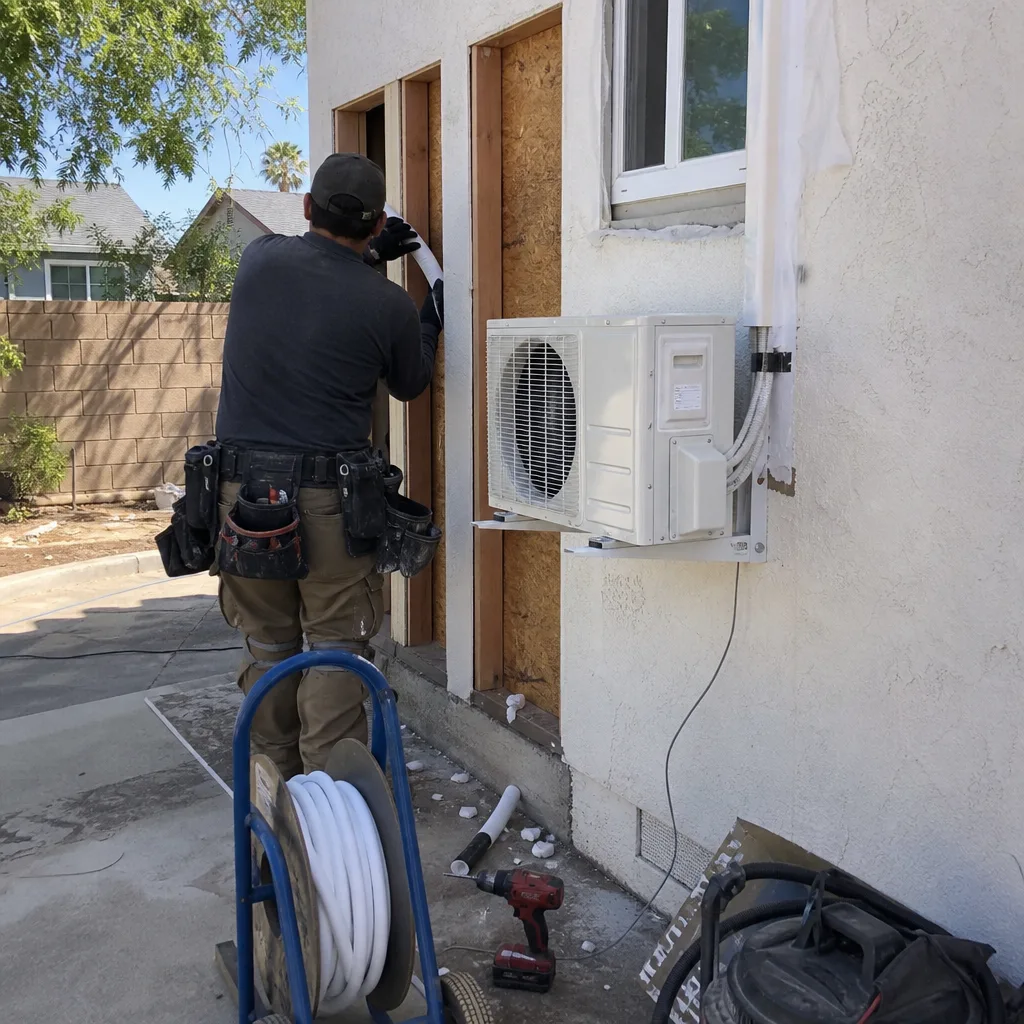
- Filter replacement or deep cleaning. Mini-split cassette filters collect dust faster in Ontario’s dry, windy spring. Wash reusable filters with mild detergent; replace disposable media. Restricted airflow is the leading cause of compressor overwork in ADUs.
- Refrigerant pressure check. Low refrigerant indicates a leak. In Ontario’s heat, a system running 10% low on charge can trip high-pressure safeties or burn the compressor. We document pressures in the photo record - Haven Standard, Clause 3.
- Condensate drain clearing. Algae and dust plug drains quickly in dry climates. A backed-up drain shuts the system or floods the wall cavity. We blow the line and verify flow at the exterior termination.
- Condenser coil cleaning. Ontario’s Santa Ana winds deposit fine dust that insulates coils. A 20% efficiency drop is common by June without cleaning.
- Thermostat calibration and programming. We verify the unit holds setpoint within 2°F and program setback schedules that reduce runtime during peak rate hours. Ontario’s ADU tenants often run units continuously; proper programming cuts utility costs 15-25%.
For garage conversion ADUs in Ontario, this checklist expands. Garage structures often have minimal insulation in the roof plane, and the mini-split works harder to overcome heat gain through uninsulated garage doors or shallow ceiling cavities. We inspect the thermal boundary - the plane separating conditioned space from unconditioned - and note deficiencies in the photo record. If the original garage door remains as a design element, we verify weatherstripping integrity and recommend insulated panel replacement when the seal fails.
Cost context: pre-season HVAC service in Ontario’s market runs $180-$320 for a single-zone mini-split. A compressor replacement in July, with emergency rates and tenant displacement, typically exceeds $2,800. See our ADU Cost Breakdown: The Ontario Homeowner’s Reference for 2026 for fuller cost analysis. The math is straightforward.
Santa Ana Season Prep: Wind, Fire, and Exterior Integrity
Ontario sits within San Bernardino County’s fire hazard severity zones, and the Santa Ana wind season - October through January, with peak events in November - drives the region’s most destructive fires. ADUs, particularly detached units and garage conversions with separate utility meters, have exterior penetrations and independent ventilation that main houses lack. These are vulnerability points.
Our October prep focuses on three systems: envelope sealing, vent protection, and defensible space.
Envelope sealing. We inspect exterior caulk at all penetrations: mini-split line sets, electrical conduit, plumbing vents, and window perimeters. In Ontario’s thermal cycling - 40°F swings in 24 hours are common in Santa Ana events - caulk fails by fatigue, not age. We look for gaps wider than 1/8 inch, separation from either substrate, and powdering at the surface. Re-caulk with exterior-grade silicone or polyurethane; latex acrylic degrades too quickly in UV.
Vent screen integrity. Dryer vents, bathroom exhausts, and kitchen range hood terminations need 1/4-inch or finer metal mesh screens. Embers enter through openings as small as 1/8 inch. We replace plastic or fiberglass screens - they melt - and verify damper closure. A backdraft damper that sticks open is an ember pathway.
Defensible space clearance. Ontario’s municipal code requires 100 feet of defensible space in State Responsibility Areas. For ADUs on typical 6,000-8,000 square foot Ontario lots, this often means the entire property. We clear dead vegetation within 30 feet of the ADU, limb up trees to 6 feet, and relocate woodpiles, propane tanks, and combustible storage. This is not aesthetic gardening; it’s code compliance that affects insurance coverage.
Wind-specific checks: Santa Ana gusts in Ontario regularly exceed 50 mph. We inspect roof-mounted equipment - solar panels, satellite dishes, mini-split condensers on platforms - for secure anchorage. A condenser torn from its pad destroys refrigerant lines and the electrical whip. We document anchor torque and pad condition in the photo record.
For new detached ADUs in Ontario, we verify that James Hardie fiber-cement siding, where specified, has no impact damage from wind-borne debris. Hardie holds up to UV and thermal cycling better than vinyl in Ontario’s climate, but the trim and sealant joints need the same annual inspection as stucco.
Winter Freeze Protocol: Protecting Exterior Plumbing
Ontario’s winter lows average 42°F in December and January. But the Inland Empire sees hard freeze events - temperatures below 28°F for four or more hours - roughly every three to five years. The January 2007 freeze damaged thousands of exterior plumbing systems across San Bernardino County. ADUs are more vulnerable than main houses because their plumbing often runs in exterior walls or shallow trenches to reach detached units.
Coastal ADU guides ignore freeze risk entirely. Ontario homeowners cannot.
At-risk fixtures in Ontario ADUs:
- Exterior hose bibs on ADU walls, especially north-facing
- Pool equipment and irrigation backflow preventers serving ADU landscaping
- Water supply lines in unconditioned crawl spaces or attic trusses
- Condensate lines from mini-splits that terminate above grade
- Graywater or laundry-to-landscape systems with above-ground distribution
Pre-freeze protocol (implement before December 1):
- Drain and shut off exterior hose bibs at the interior isolation valve. Open the exterior valve to drain the standing water in the wall cavity. If no isolation valve exists, we install one - it’s a $140-$220 line item that prevents $800+ in drywall and trim repair.
- Insulate exposed supply lines in unconditioned spaces with split-foam pipe insulation minimum 3/4 inch thick. We prefer closed-cell foam; fiberglass sleeve compresses and loses R-value.
- Verify mini-split condensate drain pitch. A drain that holds water will freeze and crack the line. We check for continuous downward slope to the termination point.
- Service irrigation backflow preventers. These assemblies have test cocks and relief valves that freeze and split. We drain the body and insulate the assembly, or remove and store smaller units.
- Confirm thermostat programming maintains 55°F minimum in unoccupied ADUs. Vacant units with setback to 45°F or “off” have frozen pipes in Ontario’s hard freeze events.
For ADU design and permitting in Ontario, we now specify interior wall plumbing runs and conditioned utility chases on new detached units. The incremental construction cost - typically $400-$800 in framing and insulation - eliminates the freeze risk entirely. Retrofit solutions for existing ADUs focus on the protocol above.
Stucco and Exterior Paint: Inland Empire UV and Thermal Cycling
Ontario receives 280+ days of sun annually and UV indices that exceed 10 in summer. Stucco surfaces in the Inland Empire experience greater thermal expansion stress than coastal equivalents because daily temperature swings are wider - 25°F versus 15°F near the ocean. This cycling opens hairline cracks that admit water, which then evaporates and deposits salts that widen the crack.
The standard “inspect every few years” advice from generic guides is wrong for Ontario. We recommend 18-month inspection intervals for stucco and exterior coatings on ADUs.
Inspection protocol:
- Hairline crack mapping. We photograph and date all cracks wider than 1/16 inch. Cracks that lengthen or widen between inspections indicate structural movement or lath corrosion requiring evaluation. Stable hairlines get elastomeric coating.
- Sealant joint condition at all penetrations. Windows, doors, electrical boxes, and light fixtures break the stucco plane. Failed sealant here is the leading cause of moisture intrusion in Ontario ADUs - not roof leaks, as homeowners assume.
- Chalk and fade assessment. Rub the surface with a dark cloth. Heavy chalking indicates binder breakdown; the coating no longer protects the cement base. In Ontario’s UV, premium acrylic coatings last 7-10 years; economy grades fail in 4-5.
- Ground clearance verification. Stucco must terminate 2 inches minimum above hardscape, 6 inches above soil. In Ontario’s clay soils, irrigation splash and wicking are constant moisture sources. We see more damage from improper grade than from rain.
For garage conversion ADUs, the original garage door opening is a critical vulnerability. The infill - whether framed wall, window assembly, or new door - moves differentially from the concrete foundation. We inspect the sealant joint at this transition every 18 months without exception. A gap here admits water that rots the sill plate and invites termite activity.
Paint specification matters in Ontario. We specify 100% acrylic latex with titanium dioxide pigment and LRV (Light Reflective Value) above 55 on south and west walls. Dark colors absorb more thermal energy and accelerate both substrate movement and coating degradation. For clients who want dark accent walls, we specify elastomeric systems rated for 400% elongation.
Drainage and Rain Season: January-March in Ontario
Ontario’s annual rainfall averages 15 inches, concentrated in brief, intense events between January and March. The city’s clay soils absorb water slowly; a 1-inch-per-hour storm generates sheet flow that pools against foundations and overwhelms undersized drainage. ADUs, with their smaller footprint and often compacted construction backfill, are more prone to drainage failure than main houses.
We schedule drainage inspection for the first two weeks of December - before the rain window, not during it.
Downspout and roof drainage:
- Verify all downspouts terminate 5 feet from foundation or connect to underground drains
- Clear gutters of ash and dust accumulation from fire season - Ontario’s dry fall deposits significant debris
- Check for gutter sag or improper pitch that causes overflow against the ADU wall
- Inspect rain leaders (underground drains) with water flow test; roots and construction debris plug these frequently
Area drains and surface grading:
- Confirm positive grade away from ADU foundation minimum 6 inches in 10 feet
- Clear area drain grates and basins of sediment - construction backfill settles and blocks inlets
- Test sump pumps in ADU crawl spaces or below-grade utility rooms; verify float switch operation and discharge line termination
Hardscape and permeability:
Ontario’s municipal code encourages permeable surfaces to reduce runoff. But permeable pavers and decomposed granite installations clog with Inland Empire dust and require annual maintenance many homeowners overlook. We inspect infiltration rates and recommend pressure washing or topping with fresh DG where compaction has sealed the surface.
For Ellery ADU Studio Ontario home clients, we document drainage condition in the photo record at 12-month intervals. When we find grade settlement against a foundation, we specify correction with compacted fill - not just cosmetic regrading - to restore the original drainage design.
Year-Round Basics: Filters, Detectors, and Documentation
Some maintenance tasks don’t follow Ontario’s seasonal pattern but still need calendar discipline. We tie these to predictable events - daylight saving time changes, property tax due dates, lease renewal - so they actually happen.
Smoke and CO detector test: Test all units monthly; replace batteries at daylight saving changes. Ontario’s building code requires hardwired interconnected detectors in ADUs, but battery backups fail silently. We document test dates in the photo record.
Water heater maintenance: Flush sediment annually. Ontario’s municipal water supply, drawn from local wells and imported sources, carries mineral content that accumulates quickly in tank and tankless units. A 10-minute flush extends element life and maintains efficiency. For tankless units - common in ADU applications - descale every 2-3 years depending on hardness.
Dryer vent cleaning: Clean the full duct run annually. Ontario’s dry climate doesn’t reduce lint accumulation; if anything, static charge in low humidity increases lint adhesion. We measure airflow at the exterior termination; below 1,000 FPM indicates significant blockage.
Documentation discipline: This is where ADU Design & Permitting in Ontario intersects with long-term care. Every Ellery ADU Studio Ontario client receives:
- The permitted drawing set - the legal definition of what was built
- A photo record at substantial completion showing concealed conditions
- Equipment schedules with model numbers, warranty terms, and filter specifications
- The Haven Standard warranty document with 365-Day Done Right Promise terms
When a repair is needed, this documentation eliminates guesswork. The technician knows what equipment is installed, where lines run, and what the original scope included. Homeowners who lack this documentation pay for diagnostic time that documentation would have eliminated.
Prefab and Modular ADU-Specific Care
Ellery ADU Studio Ontario specifies and coordinates prefab and modular systems from Plant Prefab, Tuff Shed, James Hardie, Abodu, and other manufacturers. These systems have maintenance profiles that differ from site-built ADUs - not less maintenance, but different points of attention.
Plant Prefab units: The steel moment frame and panelized envelope perform well in Ontario’s seismic and thermal environment. We inspect the panel-to-panel sealant joints annually; these are factory-applied and may need refresh at year 5-7 in high-UV exposure. The integrated mechanical systems - often packaged in a utility core - need the same HVAC service as site-built, but access is more compact. We verify service clearance before scheduling.
Tuff Shed conversions: The proprietary steel frame and wood panel system requires specific fastener torque checks at 12 and 24 months. Thermal cycling loosens the frame connections that ship loose and field-tighten. We also inspect the factory-applied sealant at roof panel laps; Tuff Shed’s standing seam profile sheds water well, but sealant degradation at endlaps is the common failure point.
Abodu units: The Abodu One and Two models use a proprietary envelope with integrated mechanicals. The mini-split is pre-charged and tested at the factory, but the line set connection at the exterior wall needs annual leak inspection. The roof membrane - a single-ply TPO or modified bitumen depending on specification - needs debris clearing and seam inspection, particularly after Santa Ana wind events that deposit sharp debris.
For all prefab systems, warranty terms vary by component. The structural warranty may run 10 years; the mechanical warranty is typically 2-5 years from the manufacturer, not the install date. We maintain a warranty calendar for each prefab ADU we service and notify clients of expiration windows.
Common Mistakes to Avoid
- Following coastal maintenance schedules. A San Diego guide that says “service HVAC annually in spring” puts Ontario homeowners six weeks late. The heat window opens earlier inland, and contractor availability compresses.
- Ignoring the Santa Ana wind calendar. Homeowners who wait until November to clear defensible space are scrambling during red flag warnings. October prep is non-negotiable in Ontario’s fire hazard zones.
- Assuming “Southern California” means no freeze risk. Ontario’s hard freeze events are infrequent but destructive. Exterior hose bibs and irrigation backflows are the most common casualties; isolation valves and drain protocols prevent them.
- Deferring stucco inspection until visible damage appears. By the time staining or efflorescence is visible, moisture has compromised the lath or sheathing. The 18-month inspection interval catches deterioration before it becomes structural.
- Neglecting documentation handoff from builder to owner. ADUs without permitted drawings and equipment schedules cost more to maintain. Technicians charge diagnostic time to determine what they’re working on.
- Using economy exterior coatings on south and west walls. The UV differential in Ontario means these surfaces degrade 40% faster than north-facing. Specifying uniform coating quality wastes money on protected surfaces and under-protects exposed ones.
- Failing to adjust thermostat programming for vacancy. Unoccupied ADUs set to “off” or 45°F have frozen pipes in hard freeze events. Minimum 55°F protects the investment; the incremental utility cost is negligible against repair expense.
When to Call a Professional
Some conditions require evaluation beyond homeowner maintenance. Call a licensed contractor when you observe: cracks in stucco that widen or lengthen between inspections; water stains on interior ceilings or walls that persist after gutter cleaning; mini-split systems that cycle rapidly, fail to reach setpoint, or produce ice on the coil; gas odors or CO detector alarms; or any electrical panel that hums, smells, or trips breakers repeatedly.
For ADU-specific concerns - permit compliance, setback verification, or scope questions on renovation work - Ellery ADU Studio Ontario offers free estimates in Ontario. Call (951) 577-3472. We also provide a Free Second Opinion on any written estimate already in hand, with documentation of what we find compared to the proposed scope.
Frequently Asked Questions
Annual maintenance for a typical Ontario ADU runs $600-$1,200 including pre-summer HVAC service, Santa Ana prep, winterization, and drainage inspection. Prefab systems with integrated mechanicals may run slightly lower; garage conversions with complex envelope transitions may run higher. Call (951) 577-3472 for an exact quote - estimates are free, and every project is quoted with a written price before any work begins under Haven Standard, Clause 1.
No. Under Clause 5 (No Surprises) of The Haven Standard, the scope is locked at signing. If we find concealed conditions that require additional work, we document them with photos and present a written change order - not a door-side upsell. The original quoted price does not increase without your written approval of a new scope.
Routine maintenance - filter changes, caulking, gutter cleaning - does not require permits in Ontario. Work that alters structural, electrical, or plumbing systems does. For details, see ADU Permits, Codes & Inspections in CA: What You Need to Know. We pull permits and schedule inspections for all work that requires them, and we include permit costs in the written quote.
Ontario’s Inland Empire location brings triple-digit summer heat, wider daily temperature swings, Santa Ana wind exposure, and occasional hard freezes - none of which affect coastal Los Angeles significantly. Maintenance intervals calibrated to LA norms fail early in Ontario. The 18-month stucco inspection and pre-June HVAC service are specific to this climate.
Prefab systems have factory-applied sealants and proprietary connections that need manufacturer-specific inspection. Panel-to-panel joints, roof membrane laps, and frame fastener torque checks don’t exist in site-built construction. We maintain manufacturer-specific checklists for Plant Prefab, Tuff Shed, Abodu, and other systems we specify.
Premium 100% acrylic latex properly applied over prepared stucco lasts 7-10 years on protected surfaces in Ontario, 5-7 years on south and west walls. Elastomeric systems extend this to 10-15 years but require higher initial investment. Economy coatings fail in 4-5 years across all exposures. We specify and quote coating systems with documented service life, not generic “paint.”
You need the permitted drawing set (the legal record of what was approved), equipment schedules with model and serial numbers, warranty documents with expiration dates, and a photo record of concealed conditions at completion. Ellery ADU Studio Ontario provides all of these on every project. If your builder did not, we can often reconstruct the record through permit research and field verification - call for a scope and written price.
The Bottom Line
Ontario’s Inland Empire climate demands a maintenance calendar that coastal guides cannot provide. Pre-summer HVAC service before June 1, Santa Ana wind and fire prep in October, winter freeze protection before December, and drainage clearing before January’s rain window - these four seasonal anchors protect the most common failure points. Between them, 18-month stucco inspection and year-round detector and filter discipline preserve the asset. The cost of prevention is modest against the cost of repair, tenant displacement, and accelerated depreciation. Document everything, inspect on schedule, and adjust for Ontario’s specific conditions rather than generic Southern California advice.
Written by Nadia Ellery, Owner at Ellery ADU Studio Ontario, serving Ontario since 2015.